My Hometown, Chengdu
My hometown, Chengdu, which is the capital city of Sichuan Province and the largest city in Southwestern China. As one of the economic and demographic centers in China, Chengdu is sometimes called the nation’s “fifth city”, after Beijing, Shanghai, Guangzhou, and Shenzhen.


However, although Chengdu is a very big and modern city, it has a different rhythm from Beijing or Shanghai. Life there feels a little slower, more relaxed, and more connected to food, tea, friends, and everyday comfort.
Thanks to Chengdu Metro, one of the largest urban railway transportation systems in China with more than 700 kilometers of lines, visitors can easily explore the city by public transport. (But you cannot see the complete route map on Google Maps since Google left Chinese mainland market in 2010 so please use local navigation apps when traveling around China not just in Chengdu.)
 |
| route map of Chengdu Metro |
Chengdu also has 4 main railway stations and 2 airports, so it is also convenient to visit from other cities. (But I do not really like the new built Tianfu Airport - if you’ve ever been to Tokyo Narita Airport you must know what I'm talking about.)
When talking about Chengdu, many people first think of giant pandas. The Chengdu Research Base of Giant Panda Breeding, which has over 250 captive giant pandas, is one of the most famous places in the city and the world’s largest artificially bred giant panda conservation population. For many visitors, seeing pandas is one of the most memorable parts of Chengdu.

Food is another important part of Chengdu’s identity. In 2010, Chengdu joined the UNESCO Creative Cities Network and became a UNESCO City of Gastronomy. Chengdu is one of the most important centers of Sichuan cuisine. Chengdu hotpot is probably the most famous dish, but there are also many local snacks, such as dandan noodles or mapo tofu. Also, Sichuan cuisine is not only spicy, as many people imagine. It has many sweet, sour, fresh, and complex flavors as well, so it is very interesting for visitors to explore.
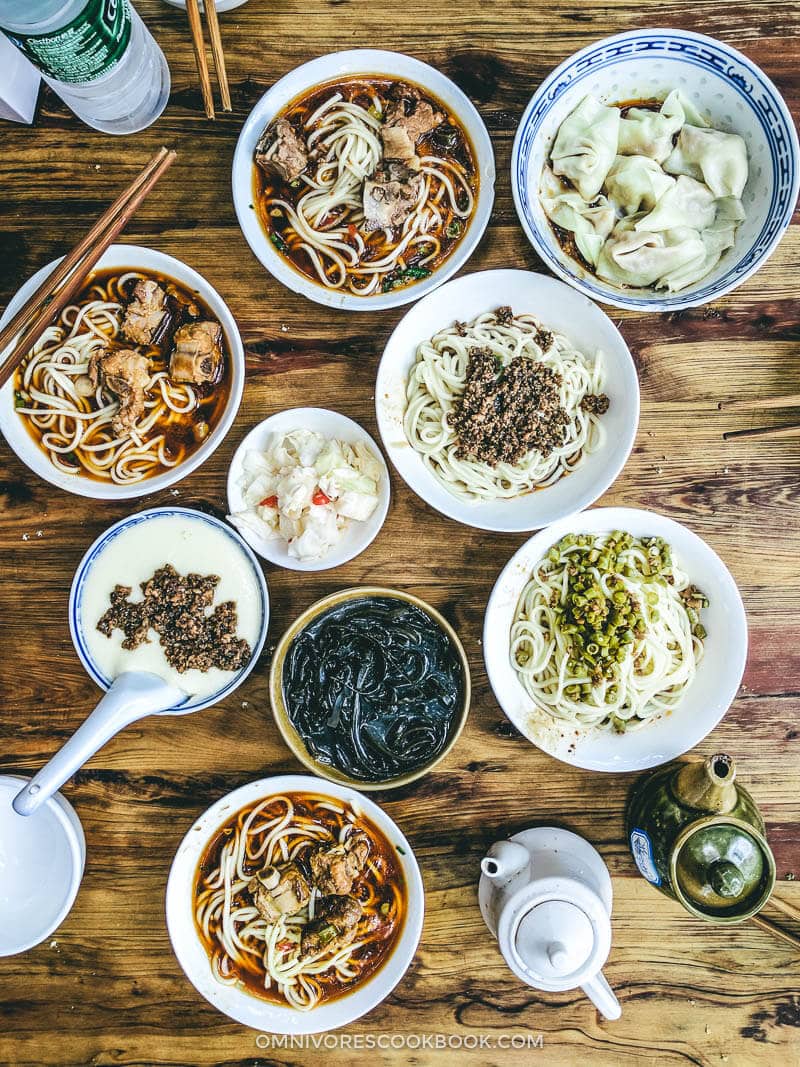 |
| traditional Chengdu snacks: noodles with various toppings, douhua(soft tofu pudding), chaoshou(Sichuan-style wontons) |
Chengdu also has rich culture and entertainment. Historically, the city is shaped by the Shu-Han culture of the Three Kingdoms period, giving it a unique historical atmosphere in Southwestern China. Mount Qingcheng, located in the suburbs of Chengdu, is known as one of the birthplaces of Taoism, which values nature, balance, simplicity, and living with the flow of life. Because Chengdu has experienced several large waves of migration since ancient times, its culture has become open, inclusive, and diverse. Nowadays, Chengdu is also young and creative, with many cafes, bars, live houses, music festivals, and night-time activities. In recent years, it has also become an core city for Mandarin rap and Chinese independent music.
| MASIWEI, a famous rapper from Chengdu, with Rich Brain |
However, Chengdu also has its own problems. Air pollution can sometimes be difficult to disperse especially in winter, as a result of its location in the Sichuan Basin. The job market is another issue. In recent years, many people have moved to Chengdu because of its relaxed lifestyle and lower living costs compared with Beijing or Shanghai, but the number of high-quality jobs has not always grown fast enough.
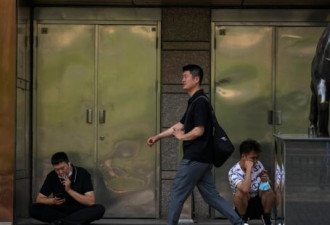
Because of this, Chengdu can feel comfortable for daily life, but not always easy for career development. To me, this also makes Chengdu more real: it is not only a tourist image of pandas, hotpot, and a slow lifestyle, but also a city facing pressure from its own rapid growth.
Comments
Post a Comment